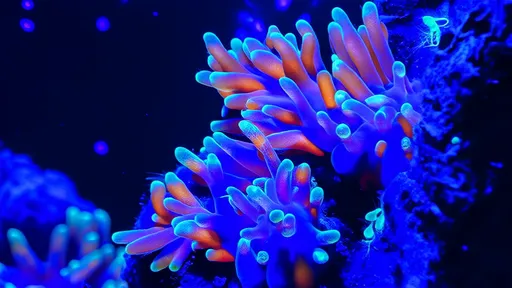
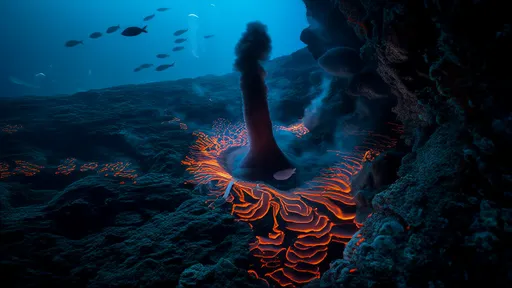
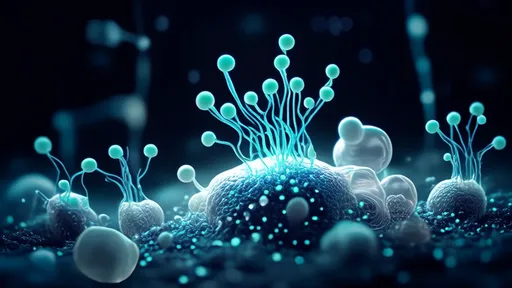
In a groundbreaking discovery that could revolutionize coral reef monitoring, marine biologists have identified spectral "early warning signals" emitted by stressed corals before visible bleaching occurs. The phenomenon, dubbed "fluorescent beaconing," involves intricate light-based communication between coral polyps and their symbiotic algae that becomes distorted under thermal stress.
The research team from Australia's Marine Science Institute spent seven years documenting subtle shifts in coral fluorescence patterns across three major reef systems. Using hyperspectral imaging technology capable of detecting wavelength variations invisible to the naked eye, they discovered that certain fluorescent signatures consistently appeared 24-48 hours before traditional bleaching indicators. These optical distress signals originate from the complex biochemical negotiation between corals and their zooxanthellae symbionts as the partnership begins to destabilize.
Dr. Eleanor Sinclair, lead author of the study published in Nature Marine Biology, explains: "Corals don't wait until they're starving to sound the alarm. What we're seeing is essentially a cellular SOS - specific fluorescence patterns that emerge when the photosynthetic machinery of the symbionts starts malfunctioning but before the algae get expelled." The team identified twelve distinct spectral fingerprints corresponding to different stress pathways, including heat stress, pollution, and freshwater intrusion.
Perhaps most intriguing is the discovery that some coral species appear to use fluorescent signals to "call for help" from more thermally resistant algae strains. The spectral patterns trigger biochemical responses in nearby free-living zooxanthellae, potentially facilitating symbiont shuffling before severe damage occurs. This finding overturns previous assumptions that symbiont exchange only happens after bleaching events.
The implications for reef conservation are profound. Current monitoring systems typically detect bleaching only when corals have already lost significant symbiont populations. The new spectral signatures allow intervention during the pre-bleaching phase when corals still retain most of their energy reserves. Marine stations across the Great Barrier Reef are already testing prototype "spectral sentinel" buoys that continuously monitor these fluorescence patterns.
However, the technology faces challenges in real-world implementation. Water depth, ambient light conditions, and coral species variability all influence spectral readings. The research team is developing AI algorithms to filter out environmental noise and create standardized fluorescence indices. Early field tests show 89% accuracy in predicting bleaching events 36 hours in advance - a critical window for implementing localized cooling measures or shading systems.
Conservationists emphasize that while this breakthrough improves response capabilities, it doesn't reduce the need for addressing root causes of reef decline. "Spectral monitoring gives us time to deploy temporary mitigations," notes coral ecologist Dr. Rajiv Patel, "but we're still racing against rising sea temperatures and ocean acidification. This is an early warning system, not a cure."
The discovery has also sparked interest in other symbiotic systems. Researchers are investigating whether similar optical communication occurs in lichens, sponge-microbe partnerships, and even human gut microbiomes. The coral findings may represent just the first glimpse into a widespread biological language of light-based stress signaling that evolved across multiple kingdoms of life.
As reef systems worldwide face unprecedented thermal stress, the ability to detect and interpret these fluorescent distress calls offers a glimmer of hope. The research team is now working with satellite imaging specialists to explore whether these spectral signatures can be detected from space, potentially enabling global-scale coral health monitoring. For conservation biologists, it's as if the reefs have been whispering their secrets in light all along - and we're finally learning to listen.
By /Aug 18, 2025
By /Aug 18, 2025
By /Aug 18, 2025
By /Aug 18, 2025
By /Aug 18, 2025

By /Aug 18, 2025
By /Aug 18, 2025
By /Aug 18, 2025
By /Aug 18, 2025
By /Aug 18, 2025
By /Aug 18, 2025
By /Aug 18, 2025
By /Aug 18, 2025
By /Aug 18, 2025
By /Aug 18, 2025

By /Aug 18, 2025
By /Aug 18, 2025
By /Aug 18, 2025
By /Aug 18, 2025
By /Aug 18, 2025